




Emergency
Locked out of the business? We come to your door
Locked out of your business or office: we come to the door and ask for proof you are allowed to open it.

Where
South-eastern Pennsylvania
What we cover
Chester County, Delaware County, Montgomery County, Lancaster County and Philadelphia
How we work
We are a mobile locksmith. We come to you.
What this covers
A business lockout keeps you out of your own premises: a store, an office, a workshop or a warehouse. The keys may be inside, lost, or with someone who is not there, or the lock may refuse the key it has always taken. We come to the business to open the door, and before any work begins we ask for proof that you are entitled to open it.
How we approach it
Tell us the address, which door you need opened, and what kind of door and lock it is: a glass storefront door, a steel rear door, a door with a push bar, or a keypad. A photo ID together with a lease or other paperwork in the business name is the proof we ask for. If you lease the space, the landlord or property manager may hold a key and may need to be told.
Where it stops
A business lockout covers opening the door. If keys are lost, think about which doors they opened and who could have them, because that may be the moment to rekey. If you find signs of a break-in, such as pry marks or a broken window, do not go inside; step away and call the police.
What business lockouts covers
Open a business or office door for someone allowed to open it.
Worth knowing
Make sure two people who live nearby can each open the building. A business that depends on one key holder is one missed alarm clock away from a lockout with staff and customers waiting outside. A second key holder, or a keypad on the staff door, is a small change that avoids a lot of disruption.
Check the other entrances before anything else. A rear door, a loading door or a door from a shared lobby may use a different key or be unlocked. Notice too whether the key to the main door sits on a ring that leaves with one person every night, and change that habit once the door is open again.
A lockout can reveal a gap in key control. Keep a written list of who holds a key to which door, collect keys when people leave, and keep that list somewhere other than inside the locked building. Those three habits make the next lockout much easier to handle.
Business Lockouts: questions before you call
What changes the job if I'm locked out at our glass front door with a pull handle and no outside keyhole?
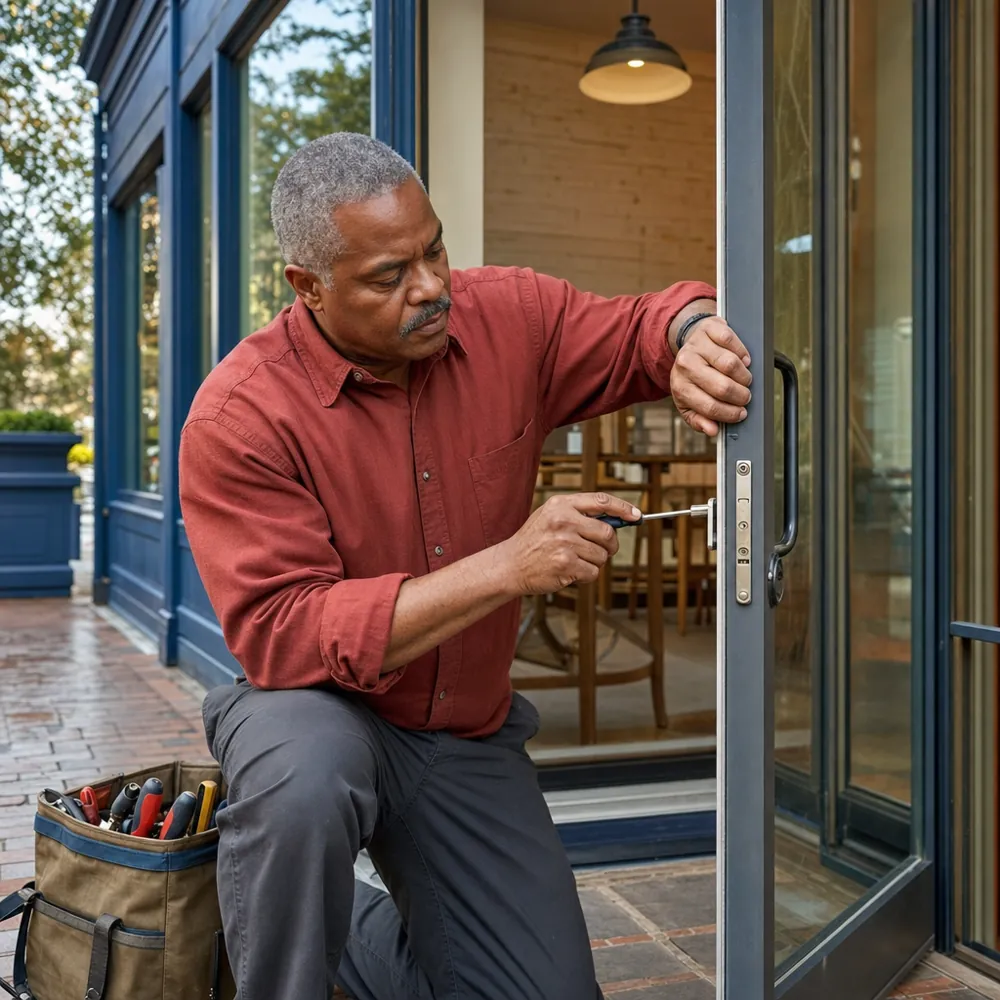
The hardware on that door changes where we start. A glass storefront door with no outside keyhole is different from a solid office door with a keyed knob or a mortise cylinder. Tell us whether the lock is in the handle, above it, or not visible from outside. A narrow metal stile around the glass is one concrete detail that helps.
What should I tell you on the phone if the back office key turns a little, then stops?
Tell us exactly what the key does and where it stops. That small movement can point to one kind of opening approach, while a key that does not enter fully points to another. Also tell us whether this is the back office, a suite entry, or a storeroom. A key stopping at about a quarter turn is a useful detail.
What do I need to have ready if our manager is out and the only keys are inside the locked shop?
Have the basic door details ready instead of the keys. We need to know which entrance you want opened, whether it is a lever handle, knob, or pull, and whether there is a second door right behind it. If the locked shop has a metal security gate across the front, say that at the start.
How is this different if I'm locked out of one office inside our building, not the main entrance downstairs?
The location inside the building matters because the door setup is different. An inner office door may be a bored cylindrical lock on a wood door, while a main entrance may be aluminum and glass with different hardware. Tell us whether you are already inside the building and facing only one locked office door. A shared hallway outside that office is one clear detail.
Does it matter that our side door has a panic bar inside and only a plain plate outside?
Yes, that matters because the outside hardware tells us a lot about the door. A plain plate outside with a panic bar inside is not the same setup as a keyed lever on both sides. Tell us whether the door is an employee entrance, a rear exit, or a suite door. A push bar running across the inside face is the key detail.
